Output from POWER UNIVARIATE LINEAR
Posted by Bruce Weaver on
URL: http://spssx-discussion.165.s1.nabble.com/Output-from-POWER-UNIVARIATE-LINEAR-tp5740814.html
I just noticed that SPSS 27 added some POWER commands. I decided to try out POWER UNIVARIATE LINEAR on the first example shown on this Stata page:
https://www.stata.com/features/overview/power-analysis-for-linear-regression-models/
Scroll down to "Here, we demonstrate PSS for an R2 test of a subset of coefficients in a multiple linear regression" to find the example. The output shows that n = 81 is needed to ensure power of 0.8 to detect a change in R^2 of 0.1 (from 0.1 to 0.2).
I used the following SPSS code to carry out the same analysis:
POWER UNIVARIATE LINEAR
/PARAMETERS MODEL=FIXED SIGNIFICANCE=0.05 POWER=0.8
TOTAL_PREDICTORS=5 TEST_PREDICTORS=2
FULL_MODEL=0.2 NESTED_MODEL=0.1 INTERCEPT =TRUE.
The results can be seen in this image:
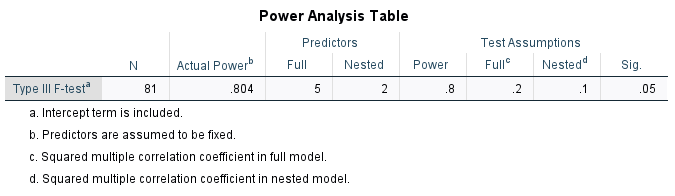
SPSS gives the same estimated sample size as Stata: n = 81. That is not the problem.
Here is the problem: The SPSS output shows there are 5 predictors in the full model, and 2 predictors in the "Nested" model. That labeling makes no sense to me given this excerpt from the command syntax:
TOTAL_PREDICTORS=5 TEST_PREDICTORS=2
If there are 5 variables in the full model, and 2 predictors that are being tested (for their impact on the change in Rsq), then surely there are 5-2 = 3 variables in the nested, or reduced model. (In the Stata output, this is shown as ncontrol = 3 and ntested = 2.)
How are others interpreting the labeling of the Full and Nested columns under Predictors? Is there a mistake in the labeling? Or am I misunderstanding something obvious?
Cheers,
Bruce
URL: http://spssx-discussion.165.s1.nabble.com/Output-from-POWER-UNIVARIATE-LINEAR-tp5740814.html
I just noticed that SPSS 27 added some POWER commands. I decided to try out POWER UNIVARIATE LINEAR on the first example shown on this Stata page:
https://www.stata.com/features/overview/power-analysis-for-linear-regression-models/
Scroll down to "Here, we demonstrate PSS for an R2 test of a subset of coefficients in a multiple linear regression" to find the example. The output shows that n = 81 is needed to ensure power of 0.8 to detect a change in R^2 of 0.1 (from 0.1 to 0.2).
I used the following SPSS code to carry out the same analysis:
POWER UNIVARIATE LINEAR
/PARAMETERS MODEL=FIXED SIGNIFICANCE=0.05 POWER=0.8
TOTAL_PREDICTORS=5 TEST_PREDICTORS=2
FULL_MODEL=0.2 NESTED_MODEL=0.1 INTERCEPT =TRUE.
The results can be seen in this image:
SPSS gives the same estimated sample size as Stata: n = 81. That is not the problem.
Here is the problem: The SPSS output shows there are 5 predictors in the full model, and 2 predictors in the "Nested" model. That labeling makes no sense to me given this excerpt from the command syntax:
TOTAL_PREDICTORS=5 TEST_PREDICTORS=2
If there are 5 variables in the full model, and 2 predictors that are being tested (for their impact on the change in Rsq), then surely there are 5-2 = 3 variables in the nested, or reduced model. (In the Stata output, this is shown as ncontrol = 3 and ntested = 2.)
How are others interpreting the labeling of the Full and Nested columns under Predictors? Is there a mistake in the labeling? Or am I misunderstanding something obvious?
Cheers,
Bruce
--
Bruce Weaver
bweaver@lakeheadu.ca
http://sites.google.com/a/lakeheadu.ca/bweaver/
"When all else fails, RTFM."
PLEASE NOTE THE FOLLOWING:
1. My Hotmail account is not monitored regularly. To send me an e-mail, please use the address shown above.
2. The SPSSX Discussion forum on Nabble is no longer linked to the SPSSX-L listserv administered by UGA (https://listserv.uga.edu/).
Bruce Weaver
bweaver@lakeheadu.ca
http://sites.google.com/a/lakeheadu.ca/bweaver/
"When all else fails, RTFM."
PLEASE NOTE THE FOLLOWING:
1. My Hotmail account is not monitored regularly. To send me an e-mail, please use the address shown above.
2. The SPSSX Discussion forum on Nabble is no longer linked to the SPSSX-L listserv administered by UGA (https://listserv.uga.edu/).
| Free forum by Nabble | Edit this page |