Re: Output from POWER UNIVARIATE LINEAR
Posted by Bruce Weaver on
URL: http://spssx-discussion.165.s1.nabble.com/Output-from-POWER-UNIVARIATE-LINEAR-tp5740814p5740816.html
Thanks for jumping in, Richard.
Actually, I like the TEST_PREDICTORS keyword in the syntax just fine. My main complaint is that the OUTPUT should say Full vs Tested under Predictors rather than Full vs Nested.
Let's go back to the example I was attempting. Here it is:
Consider a test of the significance of two covariates in a multiple linear regression adjusting for three other covariates. We will call the two covariates the tested covariates and the three others control covariates. The reduced model with the control covariates has an R2 of 0.1, and the full model with all five covariates has an R2 of 0.2. We want to compute the required sample size for the two-sided R2 test to achieve 80% power with a 5% significance level—power rsquared defaults. (Source: https://www.stata.com/features/overview/power-analysis-for-linear-regression-models/)
The Stata output, which gives the same sample size estimate as SPSS, shows the following:
power rsquared 0.1 0.2, ntested(2) ncontrol(3)
Estimated sample size for multiple linear regression
F test for R2 testing subset of coefficients
Ho: R2_F = R2_R versus Ha: R2_F != R2_R
Study parameters:
alpha = 0.0500
power = 0.8000
delta = 0.1250
R2_R = 0.1000 <<< Rsq for the reduced model with 3 variables
R2_F = 0.2000 <<< Rsq for the full model with all 5 variables
R2_diff = 0.1000
ncontrol = 3 <<< number of variables in the reduced model
ntested = 2 <<< number of variables added in the 2nd block
Estimated sample size:
N = 81 <<< This matches the result I got using SPSS
Here is the SPSS output again (so you don't have to look at another post):
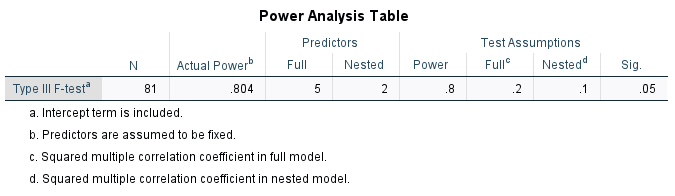
First, notice that in the Test Assumptions columns, Rsq = .2 for the Full model and Rsq = .1 for the "Nested" model. This suggests that SPSS is using "nested" model to mean "reduced" model.
Now look at the Predictors columns. The full model is correctly shown to have 5 predictors. But the "nested" (aka., reduced) model is incorrectly shown to have 2 predictors. The reduced model in this example has 3 predictors, not 2. Two predictors are added to the reduced model to reach 5 predictors in the full model. And the test is the F-test on the change in Rsq when adding those 2 variables. So NTESTED = 2, as shown in the command syntax:
POWER UNIVARIATE LINEAR
/PARAMETERS MODEL=FIXED SIGNIFICANCE=0.05 POWER=0.8
TOTAL_PREDICTORS=5 TEST_PREDICTORS=2
FULL_MODEL=0.2 NESTED_MODEL=0.1 INTERCEPT =TRUE.
Finally, if I redo the problem with k=2 variables in block 1 (the reduced model) and k=5 variables in the full model (i.e., with ntested=3), I get n = 92 as the estimated sample size. (Both SPSS and Stata give that same result.)
I hope this clarifies the nature of my complaint! ;-)
Cheers,
Bruce
URL: http://spssx-discussion.165.s1.nabble.com/Output-from-POWER-UNIVARIATE-LINEAR-tp5740814p5740816.html
Thanks for jumping in, Richard.
Actually, I like the TEST_PREDICTORS keyword in the syntax just fine. My main complaint is that the OUTPUT should say Full vs Tested under Predictors rather than Full vs Nested.
Let's go back to the example I was attempting. Here it is:
Consider a test of the significance of two covariates in a multiple linear regression adjusting for three other covariates. We will call the two covariates the tested covariates and the three others control covariates. The reduced model with the control covariates has an R2 of 0.1, and the full model with all five covariates has an R2 of 0.2. We want to compute the required sample size for the two-sided R2 test to achieve 80% power with a 5% significance level—power rsquared defaults. (Source: https://www.stata.com/features/overview/power-analysis-for-linear-regression-models/)
The Stata output, which gives the same sample size estimate as SPSS, shows the following:
power rsquared 0.1 0.2, ntested(2) ncontrol(3)
Estimated sample size for multiple linear regression
F test for R2 testing subset of coefficients
Ho: R2_F = R2_R versus Ha: R2_F != R2_R
Study parameters:
alpha = 0.0500
power = 0.8000
delta = 0.1250
R2_R = 0.1000 <<< Rsq for the reduced model with 3 variables
R2_F = 0.2000 <<< Rsq for the full model with all 5 variables
R2_diff = 0.1000
ncontrol = 3 <<< number of variables in the reduced model
ntested = 2 <<< number of variables added in the 2nd block
Estimated sample size:
N = 81 <<< This matches the result I got using SPSS
Here is the SPSS output again (so you don't have to look at another post):
First, notice that in the Test Assumptions columns, Rsq = .2 for the Full model and Rsq = .1 for the "Nested" model. This suggests that SPSS is using "nested" model to mean "reduced" model.
Now look at the Predictors columns. The full model is correctly shown to have 5 predictors. But the "nested" (aka., reduced) model is incorrectly shown to have 2 predictors. The reduced model in this example has 3 predictors, not 2. Two predictors are added to the reduced model to reach 5 predictors in the full model. And the test is the F-test on the change in Rsq when adding those 2 variables. So NTESTED = 2, as shown in the command syntax:
POWER UNIVARIATE LINEAR
/PARAMETERS MODEL=FIXED SIGNIFICANCE=0.05 POWER=0.8
TOTAL_PREDICTORS=5 TEST_PREDICTORS=2
FULL_MODEL=0.2 NESTED_MODEL=0.1 INTERCEPT =TRUE.
Finally, if I redo the problem with k=2 variables in block 1 (the reduced model) and k=5 variables in the full model (i.e., with ntested=3), I get n = 92 as the estimated sample size. (Both SPSS and Stata give that same result.)
I hope this clarifies the nature of my complaint! ;-)
Cheers,
Bruce

--
Bruce Weaver
bweaver@lakeheadu.ca
http://sites.google.com/a/lakeheadu.ca/bweaver/
"When all else fails, RTFM."
PLEASE NOTE THE FOLLOWING:
1. My Hotmail account is not monitored regularly. To send me an e-mail, please use the address shown above.
2. The SPSSX Discussion forum on Nabble is no longer linked to the SPSSX-L listserv administered by UGA (https://listserv.uga.edu/).
Bruce Weaver
bweaver@lakeheadu.ca
http://sites.google.com/a/lakeheadu.ca/bweaver/
"When all else fails, RTFM."
PLEASE NOTE THE FOLLOWING:
1. My Hotmail account is not monitored regularly. To send me an e-mail, please use the address shown above.
2. The SPSSX Discussion forum on Nabble is no longer linked to the SPSSX-L listserv administered by UGA (https://listserv.uga.edu/).
| Free forum by Nabble | Edit this page |