Re: Output from POWER UNIVARIATE LINEAR
Posted by Bruce Weaver on
URL: http://spssx-discussion.165.s1.nabble.com/Output-from-POWER-UNIVARIATE-LINEAR-tp5740814p5740818.html
Thanks very much Richard. Yes, the other Rich who posted that emailed me that same request about changing .1 to .15. The issue was that for the example I chose, Rsq for the reduced model was equal to Rsq-change, which could cause further confusion for someone trying to decipher the output. In light of that, here is another example that avoids the issue.
* Another example.
* Block 1: y = b0 +b1*x1 + b2*x2 + b3*x3 + b4*x4 + error
* Block 2: y = b0 +b1*x1 + b2*x2 + b3*x3 + b4*x4 + b5*x5 + error
* I want power of .8 to detect a change in Rsq from .4 to .45.
* The relevant test is a test on the change in Rsq when adding 1 variable,
* so NTESTED=1. And there are 4 variables in the block 1 model,
* which SPSS calls the nested model. Let's see what the output says!
* First, here is the Stata command:
* power rsquared 0.4 0.45, ntested(1) ncontrol(4) power(.8)
* Stata result: n = 89.
POWER UNIVARIATE LINEAR
/PARAMETERS MODEL=FIXED SIGNIFICANCE=0.05 POWER=0.8
TOTAL_PREDICTORS=5 TEST_PREDICTORS=1
FULL_MODEL=0.45 NESTED_MODEL=0.4 INTERCEPT =TRUE.
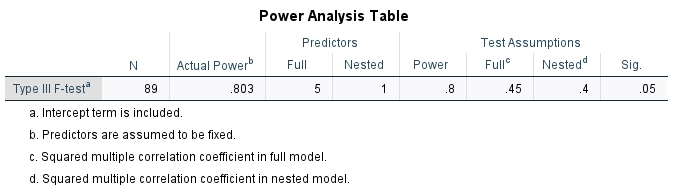
As expected, the output incorrectly shows that there is only 1 variable in the nested (or reduced, or block 1) model. There are 4 variables in block 1 and 1 "tested" variable is added to block 2.
I hope this example clarifies things for anyone who was confused by having Rsq for block 1 = Rsq change.
Cheers,
Bruce
URL: http://spssx-discussion.165.s1.nabble.com/Output-from-POWER-UNIVARIATE-LINEAR-tp5740814p5740818.html
Thanks very much Richard. Yes, the other Rich who posted that emailed me that same request about changing .1 to .15. The issue was that for the example I chose, Rsq for the reduced model was equal to Rsq-change, which could cause further confusion for someone trying to decipher the output. In light of that, here is another example that avoids the issue.
* Another example.
* Block 1: y = b0 +b1*x1 + b2*x2 + b3*x3 + b4*x4 + error
* Block 2: y = b0 +b1*x1 + b2*x2 + b3*x3 + b4*x4 + b5*x5 + error
* I want power of .8 to detect a change in Rsq from .4 to .45.
* The relevant test is a test on the change in Rsq when adding 1 variable,
* so NTESTED=1. And there are 4 variables in the block 1 model,
* which SPSS calls the nested model. Let's see what the output says!
* First, here is the Stata command:
* power rsquared 0.4 0.45, ntested(1) ncontrol(4) power(.8)
* Stata result: n = 89.
POWER UNIVARIATE LINEAR
/PARAMETERS MODEL=FIXED SIGNIFICANCE=0.05 POWER=0.8
TOTAL_PREDICTORS=5 TEST_PREDICTORS=1
FULL_MODEL=0.45 NESTED_MODEL=0.4 INTERCEPT =TRUE.
As expected, the output incorrectly shows that there is only 1 variable in the nested (or reduced, or block 1) model. There are 4 variables in block 1 and 1 "tested" variable is added to block 2.
I hope this example clarifies things for anyone who was confused by having Rsq for block 1 = Rsq change.
Cheers,
Bruce
--
Bruce Weaver
bweaver@lakeheadu.ca
http://sites.google.com/a/lakeheadu.ca/bweaver/
"When all else fails, RTFM."
PLEASE NOTE THE FOLLOWING:
1. My Hotmail account is not monitored regularly. To send me an e-mail, please use the address shown above.
2. The SPSSX Discussion forum on Nabble is no longer linked to the SPSSX-L listserv administered by UGA (https://listserv.uga.edu/).
Bruce Weaver
bweaver@lakeheadu.ca
http://sites.google.com/a/lakeheadu.ca/bweaver/
"When all else fails, RTFM."
PLEASE NOTE THE FOLLOWING:
1. My Hotmail account is not monitored regularly. To send me an e-mail, please use the address shown above.
2. The SPSSX Discussion forum on Nabble is no longer linked to the SPSSX-L listserv administered by UGA (https://listserv.uga.edu/).
| Free forum by Nabble | Edit this page |